Material, September 10, 2025
On Single-Slab Tables
Why the studio builds from one log at a time, and what gets lost when it does not.
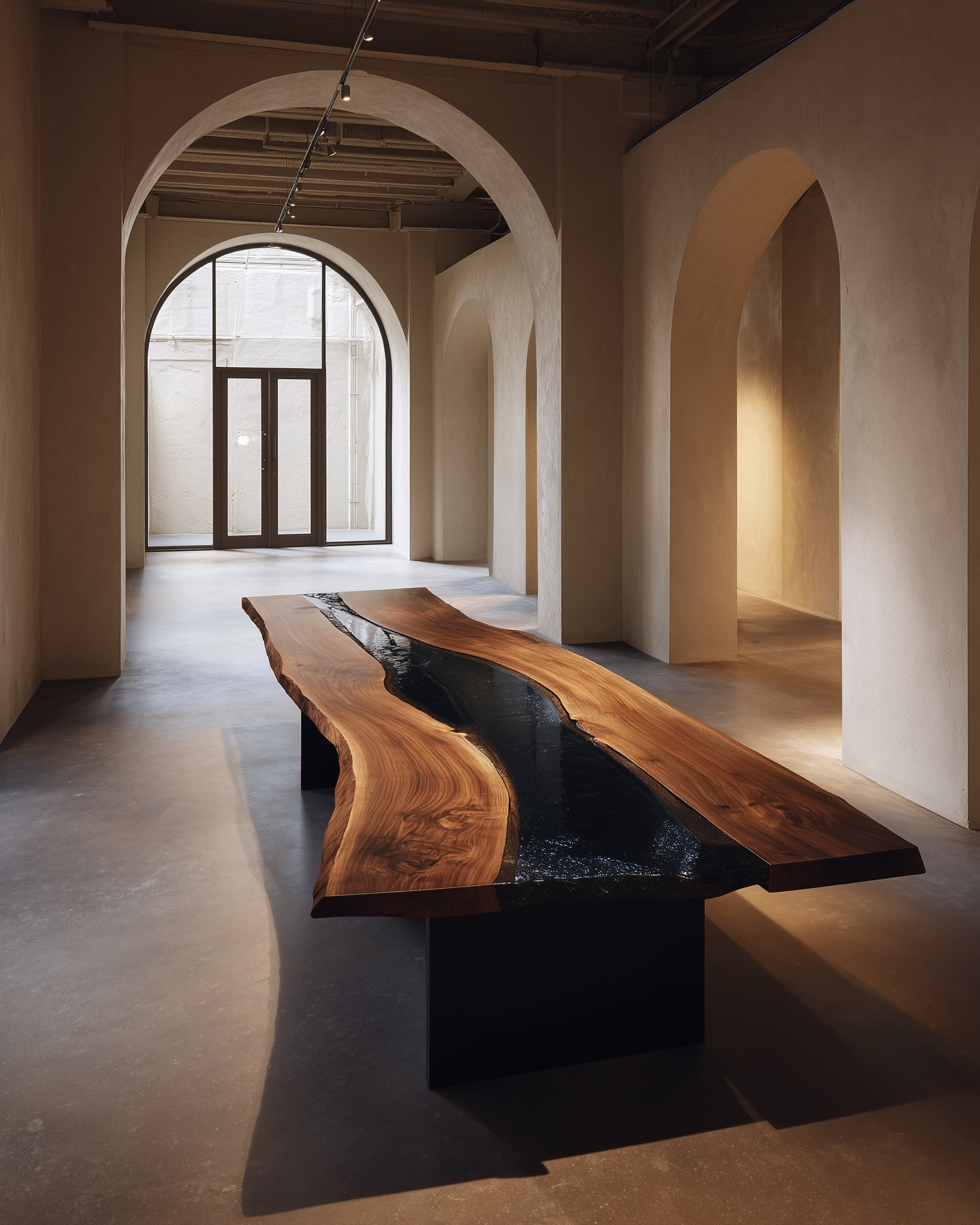
Most furniture is built from boards: narrow, straight lengths that can be glued into any width. A single-slab table is cut from one log and kept whole, so the top carries the shape of the tree, its edges, its checks and the way the grain runs from heart to bark.
That choice slows everything down. A slab has to dry before it can be worked, and thick slabs dry slowly. A common rule of thumb is about a year of air-drying per inch of thickness, followed by time in a kiln to bring the wood down to the moisture of an indoor room, roughly 6 to 8 percent. Skip that and the slab keeps moving after it ships.
Bookmatching is the other reason to work from one log. Two consecutive slabs, opened like the pages of a book, mirror each other along the joint. It only works when both come from the same cut, which is why the studio buys and stores logs rather than boards.
The trade-off is that no two pieces are the same, and the size of a table is set by the tree. We think that is the point.